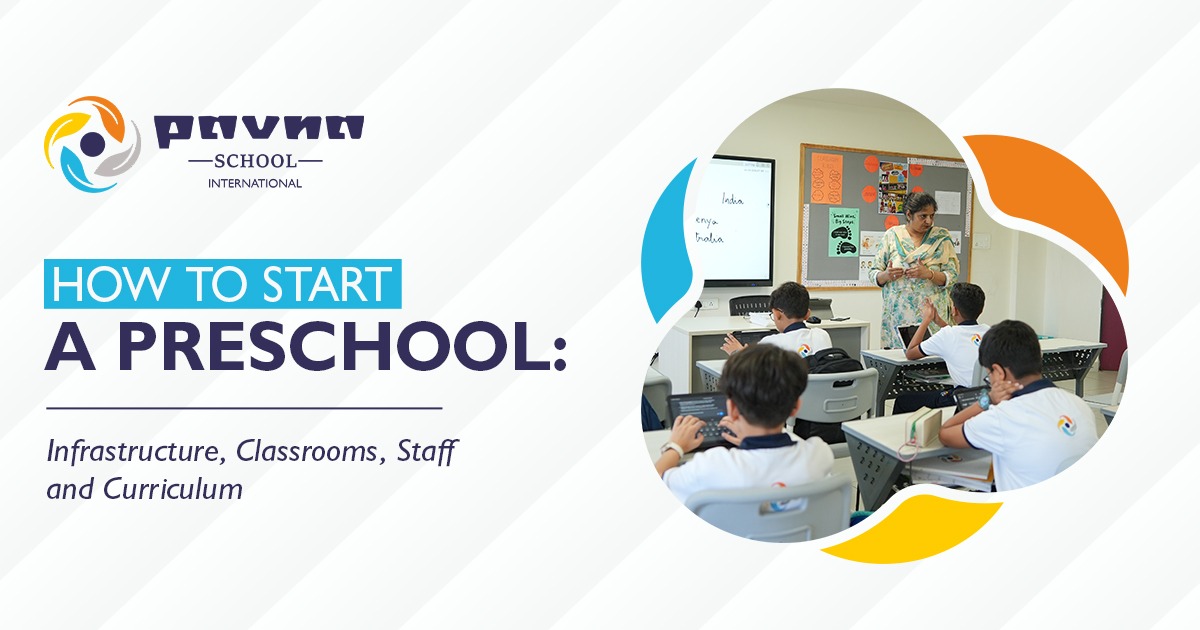
Starting a preschool takes more than enthusiasm for early education. It involves careful planning in four areas, all of which are interrelated: the physical structure, the spaces within the building, those who use and operate the building, and the actual curriculum children receive every day. Any one of these can make a difference to the whole experience, so it is best to think of them as integrated rather than as a series of checklists.
Preschool Infrastructure Requirements
Preschool infrastructure is the building block upon which all else is based. This means:
- building layout
- compliance with safety standards
- sanitation facilities
- outdoor play area
- fire/exit routes
Local regulations usually have minimum standards that must be met, for space per child, ventilation, and access to washrooms – so it may be worth checking state-specific norms before finalising a location.
Preschool Infrastructure must facilitate the movement and behaviour of young children, in addition to compliance. Wide corridors minimize crowding during transition time, ground-level classrooms ease evacuation, and a separate outdoor space allows for physical development – not available in a classroom.
Preschool Classroom Setup and Design
Infrastructure is a learning environment in the preschool classroom. Well-designed children’s rooms have to separate different activities into distinct areas of the room, e.g., a reading area, building block area, art table, and a space for group play activities. This zoning is beneficial for children to know in their own minds what they should do in each space of the room, and it doesn’t require them to be frequently reminded.
Good classroom design also includes natural light and low noise levels, as well as good sightlines for teachers to see the entire room. In a good classroom, however, it’s not chaos, but it’s the result of a good design that starts at the very beginning of the lesson.
Preschool Classroom Furniture and Decoration
Preschool classroom furniture should be sized to children’s requirements and be safe for them to use. Chairs and tables should be at a height that will allow children to use them without assistance corners should be rounded to reduce the risk of injury, and storage should be at a height that children can access independently to promote independence.
For some inexperienced preschool owners, classroom decor is a less significant aspect of the preschool than it should be. Use bright colors, learning charts and student work displayed in a room to make it welcoming, but decoration should also have a purpose – not just for its colour, for example alphabet charts by the reading corner or number lines by the math area.
Preschool Staff Requirements and Teacher Qualifications
Typical staffing levels for preschools range from the head teacher, assistant teachers, and the support staff for each classroom, and may be stipulated by local licensing authorities. This ratio is important in determining the safety of the children and the quality of child-to-child interactions.
Preschool teachers usually have skills and knowledge qualifications, such as a diploma or degree in early childhood education, and basic training in child psychology and first aid. Additionally, many preschools seek prior experience working with 3- and 4-year-old children, as handling 4-year-olds in the classroom will require patience and skills that are not necessarily obtained from a classroom-only training program.
Preschool Teacher Training
Recruitment of qualified teachers is just the first step. Preschool teacher training is ongoing so staff are kept up to date with classroom management techniques, new approaches to the curriculum, and child safety protocols. Preschools are consistent in training staff regularly, either in their own classrooms or by using a certified early childhood training program.
It will also be necessary to train the staff in real-world situations like separation, group changeovers, early developmental issues, and other situations that will occur in the preschool environment.
Preschool Curriculum and Lesson Plans
A high-quality early learning program emphasizes learning through play and structure. Most ECE curriculum frameworks are structured around the developmental milestones and not academic goals and they include content about language, motor skills, social behaviors and early number and letter recognition.
It is important that the lesson plan for a group of preschoolers is flexible enough to allow them to work at their own speed and yet is based on a monthly or termly theme. In a lesson plan (even for a single topic like “animals” or “seasons”), the teacher can link stories, art and activities to the theme so that young children can better retain the concepts than in lessons that are unrelated.
Preschool Educational Activities & Classroom Activities.
Curriculum goals can only be achieved through preschool educational activities. Color sorting, shape matching, and basic counting activities develop early math skills, and story hours and rhymes help develop language skills, all without children realizing they are formally “learning” math.
Individual and group activities should also be incorporated into classroom activities in the preschool. A variety of activities, including circle time and group games, help to develop social skills and cooperation, while individual activities like puzzles and drawing develop focus and independence. These are not necessarily repeated daily: a balanced mixture of the types of preschool curriculum activities occurs throughout the week.
Frequently Asked Questions
What is needed to launch a preschool?
A safe building plan, sanitation, fire safety, outdoor play, and sufficient classroom space, as required by local regulations, are usually essential for a preschool.
What is the best structure for a preschool classroom?
A preschool should have activity areas including building block, art, and reading areas, and have good visibility and natural light for easy teacher supervision.
What are some of the skills and attributes that a preschool teacher needs to possess?
Preschool teachers will typically require training in first aid and child psychology, as well as possession of a diploma or degree in early childhood education.
How is a preschool curriculum different from a school curriculum?
The curriculum used in preschool is based on developmental goals, such as language development, motor skills, social behaviours and is taught primarily through play.