
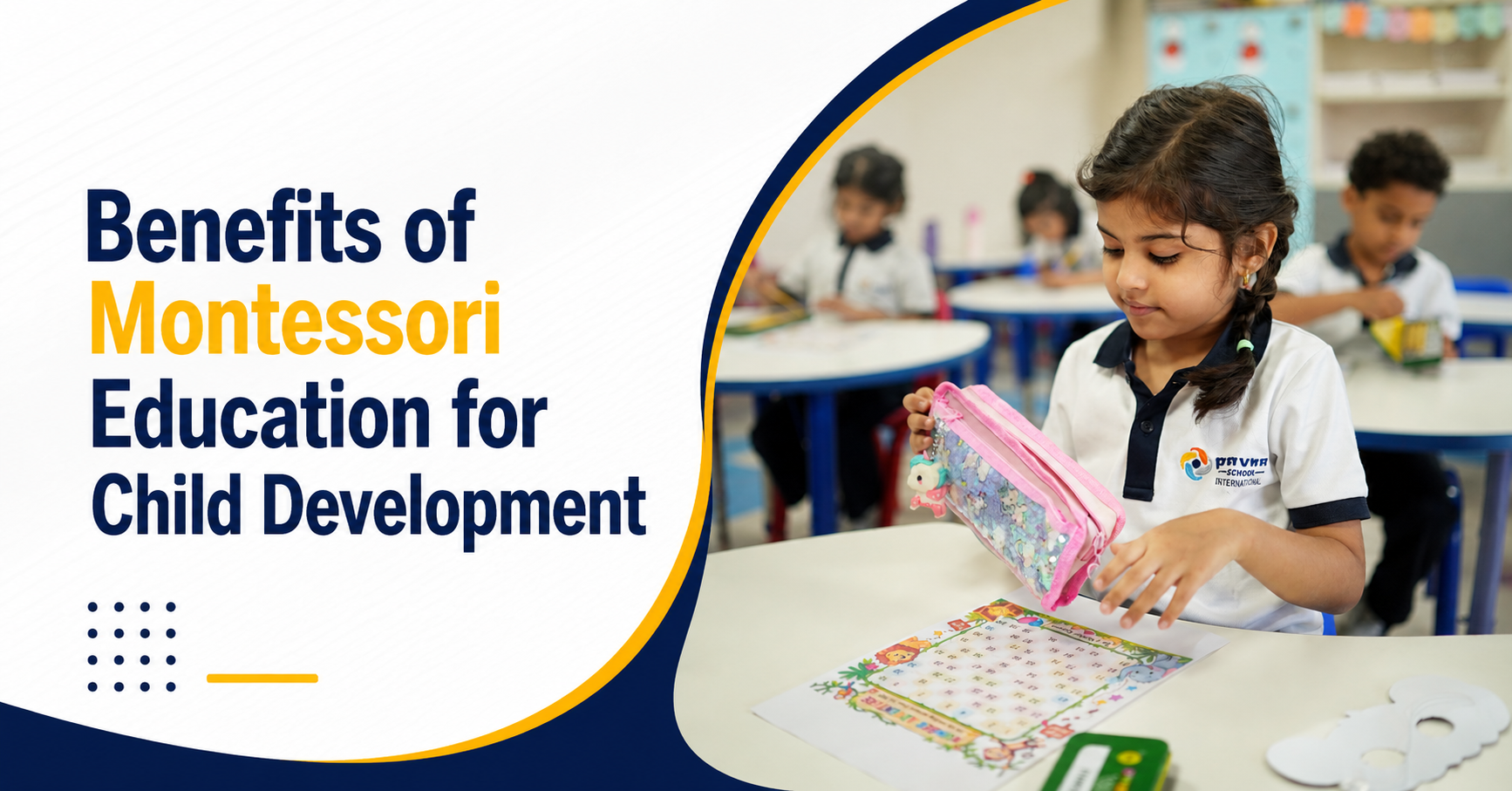
Every parent wants their child to grow up curious, confident, and capable of handling atleast basic things. The question is rarely about the goal. It is about how a child’s learning method in their earliest years shapes not just their academic ability but also their relationship with learning. And that is precisely where Montessori education stands apart.
Developed by Dr. Maria Montessori in the early 1900s and now practiced in thousands of schools worldwide, the Montessori method remains one of the most researched and respected approaches to early childhood education. This guide explains what it is, what it does, and why it might be the right choice for your child.
What Is Montessori Education?
Montessori education is a child-centered learning approach that allows children to direct their own learning within a carefully prepared environment. Rather than sitting at desks and receiving instruction from a teacher, Montessori students choose their own activities from a range of options, work at their own pace, and engage with specially designed materials that develop specific cognitive and physical skills.
The teacher in a Montessori classroom not only gives lectures but also. observe activities of students and a guide, stepping in when a child needs support and stepping back when a child is engaged and thriving. This respect for the child’s natural developmental process is the foundation of everything that Montessori education offers.
Why Early Childhood Education Matters More Than Most Parents Realize
Between birth and age six, the human brain develops a lot of connections at a pace that will never be matched again. During this period, children explore and practice, and this duration shapes their cognitive thinking for life.
It is about shaping the way a child processes information, manages emotions, relates to others, and engages with challenges. The benefits of Montessori education are most powerful when they begin during this critical developmental window, which is why nursery school admission decisions carry more long-term weight than many parents initially appreciate.
The Core Benefits of Montessori Education
1. Children Learn at Their Own Natural Pace
One of the most significant benefits of Montessori education is that it removes the pressure of keeping up with the pace of the same group. In a traditional classroom, every child is expected to learn the same concept on the same day. In a Montessori environment, a child who needs more time to learn will get it. A child who is ready to move ahead does so without waiting.
This is not a small thing. A child who is consistently asked to do work that is too difficult loses confidence. A child who is consistently held back loses interest. Montessori education is designed to keep children in what developmental psychologists call the zone of proximal development, the precise point where learning is challenging enough to be interesting but achievable enough to be rewarding.
2. Independence and Self-Motivation Are Built From the Start
In a Montessori classroom, children choose what to work on. They retrieve their own materials, complete their activity, and return materials to their place. This is not chaos. It is a deliberately structured form of autonomy that builds self-regulation, decision-making, and intrinsic motivation from a very young age.
Children who develop intrinsic motivation, the desire to learn because learning itself is satisfying, consistently outperform those who are motivated only by grades, rewards, or adult approval. This is one of the most durable benefits of Montessori education because it shapes a child’s relationship with learning far beyond the nursery years.
3. Hands-On Learning Through Specially Designed Materials
Montessori classrooms are filled with carefully designed physical materials that make abstract concepts tangible. A child learning about quantity does not just hear the number five. They hold five beads, count five objects, and build five units from a physical structure. A child learning to read does not just memorize letter sounds. They trace sandpaper letters with their fingertips, feeling the shape as they say the sound.
This multi-sensory approach to early childhood education reflects what neuroscience consistently confirms: children learn and retain information most effectively when multiple senses are engaged simultaneously. The Montessori materials are not toys. They are precisely engineered learning tools that have been refined over more than a century of classroom practice.
4. Social Development Happens Naturally
Montessori classrooms typically group children of mixed ages, often spanning three years, a three-year-old works alongside a five-year-old. Older children mentor younger ones. Younger children observe and aspire. This arrangement mirrors real-world social environments far more accurately than age-segregated classrooms, and it produces measurable social benefits.
Children in mixed-age Montessori settings develop stronger empathy, better communication skills, and greater patience than their peers in traditional settings. Older children reinforce their own understanding by explaining concepts to younger classmates, a learning technique that research consistently identifies as highly effective.
5. Concentration and Focus Are Actively Developed
In a Montessori environment, children are not interrupted once they are deeply engaged with an activity. A child who has been working on a puzzle for forty minutes is not stopped when the bell rings and told to move to the next subject. That sustained engagement is protected and valued.
This deliberate cultivation of deep focus is one of the most underappreciated benefits of Montessori education. In an age of shortening attention spans and constant digital distraction, the ability to concentrate deeply on a single task for an extended period is a genuinely rare and valuable skill. Montessori children develop it early and carry it forward.
6. Creativity and Problem-Solving Are Central, Not Optional
Montessori classrooms do not treat creativity as a Friday afternoon activity. It is embedded in the daily structure. Open-ended materials, child-directed exploration, and the freedom to approach problems in multiple ways all cultivate creative thinking as a default mode rather than an occasional exercise.
Problem-solving, similarly, is practiced constantly. Montessori materials are self-correcting, meaning a child knows immediately whether they have got something wrong without waiting for a teacher to mark their work. This immediate feedback loop builds resilience, encourages experimentation, and teaches children that mistakes are information, not failures.
7. Emotional Intelligence Develops Alongside Academic Skills
The benefits of Montessori education extend well beyond academic development into emotional development. Montessori classrooms dedicate explicit time to what the method calls ‘grace and courtesy,’ practicing how to greet someone, ask for help, and resolve a disagreement respectfully. These are not abstract lessons. They are practiced, rehearsed, and embedded in daily classroom life.
Children who develop strong emotional intelligence in their early childhood education years demonstrate better mental health outcomes, stronger relationships, and greater resilience under pressure throughout their lives. The Montessori method treats emotional competence not as a soft add-on but as a core developmental goal.
Conclusion
The benefits of Montessori education are not theoretical. They are documented across decades of research, visible in classrooms around the world, and traceable in the adults who become Montessori-educated children, Independent thinkers. Confident learners. Emotionally intelligent, socially capable, and genuinely motivated by the desire to understand the world around them.
Early childhood education is not a warm-up for real school. It is the foundation on which everything else is built. The nursery school admission decision you make for your child is one of the most consequential choices of their educational journey. It deserves the same research, the same care, and the same honest evaluation that you would bring to any major decision.
Montessori education offers a proven, principled, and deeply humane approach to that foundation. For many children, it is the best possible start.
Frequently Asked Questions (FAQs)
1. At what age should a child start Montessori education?
Most Montessori education programs accept children from age two and a half to three, with some offering infant and toddler programs from eighteen months. The benefits of Montessori education are most fully realized when children enter early and complete the full three-year mixed-age cycle. For parents planning nursery school admission, earlier entry generally allows a child to benefit more completely from the developmental cycle the method is built around.
2. How do I know if a school offering Montessori education is genuine?
Because the name Montessori is not legally protected, any school can use it regardless of whether it follows the actual method. When evaluating nursery school admission at a school claiming to offer Montessori education, look for mixed-age classrooms spanning at least three years, uninterrupted work periods of 2 to 3 hours, authentic Montessori materials in the classroom, and teachers trained by a recognized organization such as AMI or AMS. Ask to observe a classroom session before making your decision.
3. Is Montessori education suitable for all children?
The benefits of Montessori education are broad enough that most children thrive in a well-implemented Montessori environment, particularly during the early childhood education years. It is especially well-suited to children who are naturally curious and respond well to genuine autonomy. Children with more structured preferences may take longer to settle, but skilled Montessori teachers are trained to support this transition. The more important variable is always the quality of the school and its teachers, not the child’s individual temperament.